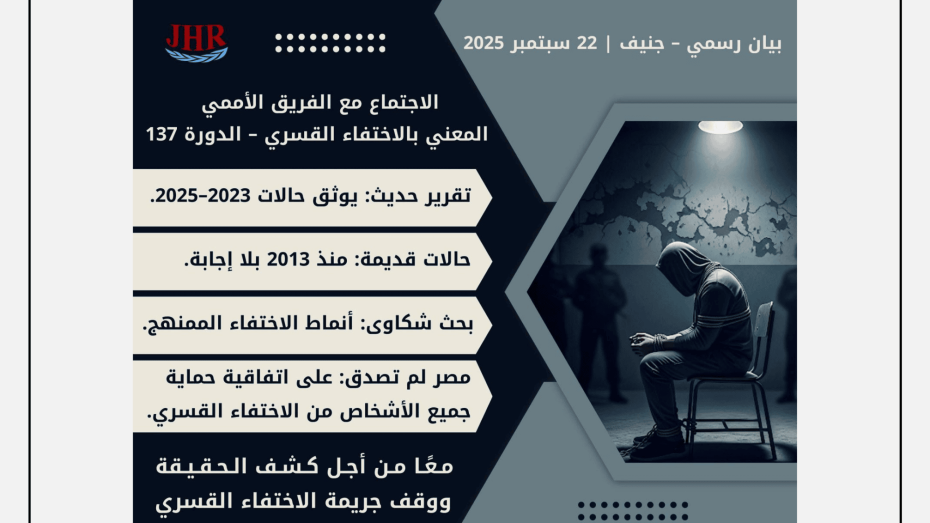
For more than thirteen years, the crime of enforced disappearance in the Arab Republic of Egypt has remained the most evident and recurrent of crimes. More than twenty thousand citizens have been subjected to enforced disappearance, according to what has been monitored and documented by human rights and media sources. A number of them later appeared before the Public Prosecution as defendants in cases of a political nature, and 65 cases of forcibly disappeared individuals have been recorded as killed, following the Egyptian Ministry of Interior’s denial of their existence — even as numerous organizations documented their disappearance through official complaints filed by victims’ families with the relevant authorities.
Hundreds of victims disappeared during the events of the Republican Guard in July 2013 and the dispersal of the Rabaa and Nahda sit-ins in August 2013 remain with their fate undisclosed to this day, in addition to 300 cases documented by JHR whose existence the Egyptian government denies, despite evidence of their arrest by police forces in official uniform, and others in plain clothes.
The gravity of the growing crime of enforced disappearance lies not only in its being an abduction and a denial of the existence of the abducted person — an arbitrary detention accompanied by severe torture and coercion into making confessions to crimes of which they have no knowledge — but, more gravely still, in its being an organized and systematic crime carried out by officials of the executive authority and those entrusted with security and protection within it.
Enforced disappearance in Egypt is no longer merely a limited, individual violation; it has expanded into a tool for suppressing freedom of expression, restricting peaceful civic activity, and curtailing all fundamental rights, its effects reaching ordinary citizens amid the abuse of exceptional authority beyond the reach of legal oversight.
After all these years, we do not tire of repeating our demand to confront the continuation of this systematic crime. There remain among the honorable and conscientious people of the world those who astonish us daily with their support for the victims of wars and violations — and the victims of enforced disappearance, in Egypt and across the world, suffer no less pain and torment than the victims of war. They suffer physically from torture, and psychologically from terror and the denial of their very existence, while entire families suffer alongside them, having lost their providers and running from door to door of prison basements and detention centers in search of them, with no one to reassure them or believe a word they say.
On the International Day of the Victims of Enforced Disappearance — observed every year in support of the victims of this crime classified as a crime against humanity, and to work toward protecting people from it — we declare that our international human rights campaign, #Where_Are_They, for the year 2026, is an ongoing effort, and we call for solidarity with it, and for the continuation of appeals and activities until this crime is fully halted and the last of the forcibly disappeared is returned to their life, their family, and their loved ones, and their unknown fate is disclosed.
Our Demands:
Egypt must ratify, without reservation, the International Convention for the Protection of All Persons from Enforced Disappearance.
The issuance of national legislation that clearly and explicitly criminalizes enforced disappearance and classifies it as a crime against humanity.
The immediate cessation of all forms of enforced disappearance and the physical, psychological, and legal violations associated with it.
The disclosure of the whereabouts of all forcibly disappeared persons, and their return to their families — not to prisons and detention centers under fabricated charges.
A review of cases and charges built upon confessions obtained from forcibly disappeared persons following periods of disappearance, prior to their appearance in courts and prosecution offices.
The closure of secret prisons and unlawful detention facilities, and the activation of judicial oversight over prisons and places of detention.
The establishment of a legal mechanism to hold accountable those responsible for enforced disappearance and the associated acts of torture, as these are crimes not subject to a statute of limitations.
We call upon the media to continue shedding light on this crime, to carry the voice of the victims, and to reject official silence.
Organizations Signing the Statement:
Justice for Human Rights Organization (JHR) — Turkey
EFD International — Belgium
Free Voice Organization — Paris
Victims of Torture Association — Geneva
International Lawyers Organization — Turkey
Tawasul for Human Rights — Netherlands
Egyptians’ Human Rights Council — Geneva
Cedar Center for Legal and Human Rights Studies — Lebanon
Solidarity for Human Rights — Geneva
Medline for Human Rights — Geneva