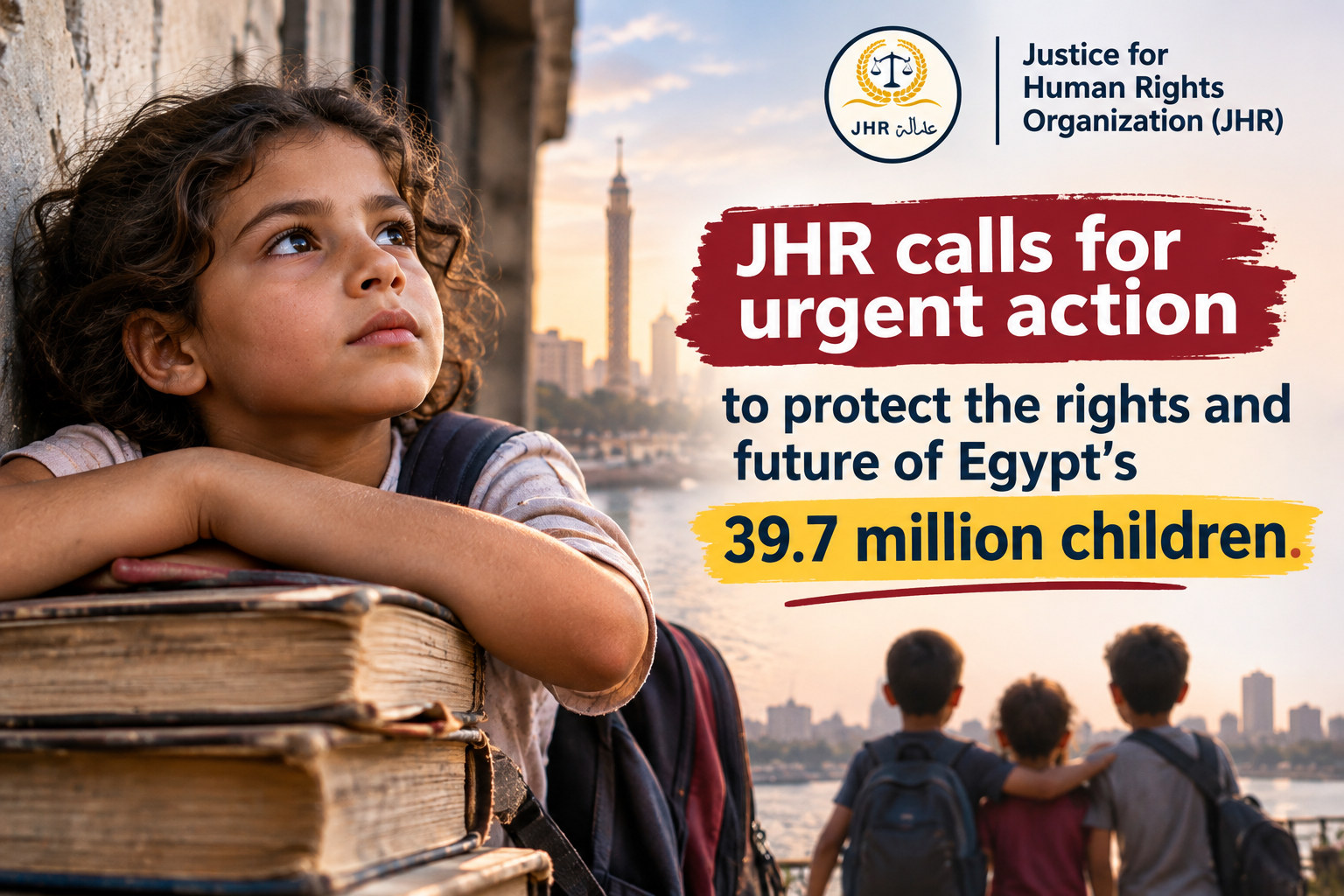

Press Release on the Occasion of World Children’s Day
Justice for Human Rights (JHR)
20 November 2026
Every year on 20 November, international attention turns to children’s rights, and this year the United Nations has adopted the theme “My Day, My Rights, My Future” to promote children’s meaningful participation in the issues that affect their lives.
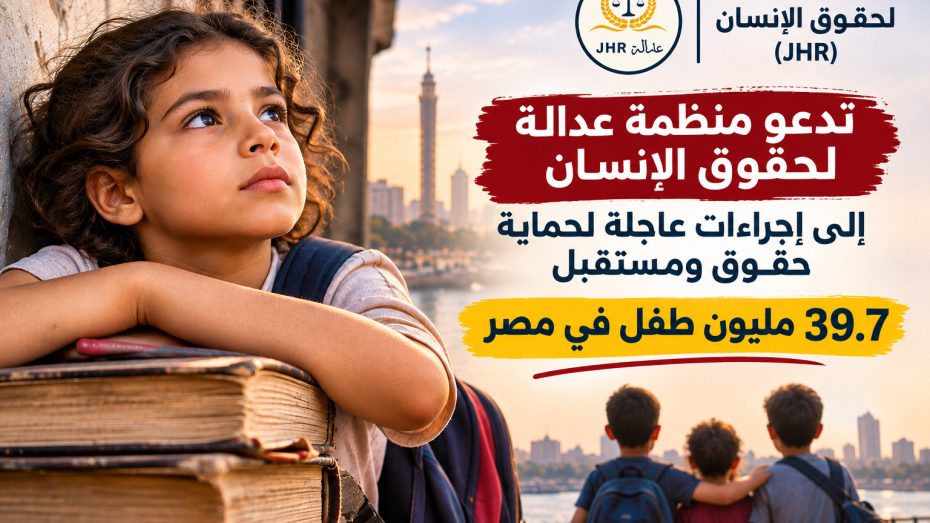
However, JHR’s assessment of the situation of Egypt’s children, who number around 39.7 million and make up more than a third of the population according to the Central Agency for Public Mobilization and Statistics (CAPMAS), reveals a deep gap on the ground.
This gap lies in the clear disparity between what children actually face and the legal obligations arising from the Convention on the Rights of the Child and the observations of the UN Committee on the Rights of the Child. This is all the more significant because Egypt was among the first states to ratify the Convention, a binding legal contract that demands accountability.
Under the weight of economic crises and rising inflation, driven by political authoritarianism, social support programs can no longer protect poor families, and children have been the first victims. Official and UN data indicate that around 1.3 million children are in the labor market, nearly 900,000 of them in hazardous occupations that endanger their bodies and lives, far from any real oversight.
At the same time, malnutrition continues to threaten children’s physical and cognitive development: 12.8% of children under five suffer from stunting and 3.1% from wasting.
Talk of development loses its meaning when a child in a village or an informal settlement is forced to leave school to support their family, or is denied the healthy food needed for proper growth.
The situation in education is not much different. The right to quality education, enshrined in the Convention and the Constitution, has become a heavy financial and psychological burden on Egyptian families.
CAPMAS data show class sizes of 39 to 46 pupils in primary school and 41 pupils in general preparatory school. In practice, these figures make proper teaching impossible and push families into the hell of private tutoring. Meanwhile, children with disabilities face mounting difficulties due to the lack of full inclusion and qualified resources, as well as administrative and economic obstacles that limit their regular attendance.
On protection from violence and harmful practices, figures from the Child Helpline (16000) show more than 453,000 calls received and more than 21,000 reports handled in a single year. This is a telling indicator of the scale of the daily risks to children’s safety within the family and the immediate environment.
Article 12 of the Convention on the Rights of the Child requires guaranteeing the child’s right to express their views freely and to be heard seriously, which aligns with this year’s UN theme. JHR stresses that children’s rights cannot be separated from the general climate of freedoms. It is practically impossible to empower children to express themselves and participate in a country that has seen an almost complete closure of the public sphere and continuous restrictions on freedom of opinion, assembly, and independent civil society work.
In the absence of free student unions and independent civil institutions, official platforms aimed at young people become facades of token representation that echo the official discourse and do not reflect children’s real concerns. More serious still is the continued prosecution and detention of minors for peaceful expression or online posts, as documented in JHR’s reports and in the observations of the UN Committee on the Rights of the Child. This is compounded by policies of blocking websites and information, which deprive new generations of their fundamental right to knowledge and to developing independent critical awareness.
Rather than serving as a tool for rehabilitating and protecting children, the justice system has, according to UN and local human rights reports, been the site of serious violations against minors in places of detention. These range from failure to accurately establish legal age, to ill-treatment and solitary confinement for some, and harsh sentences.
Alongside these long-standing failures, Egypt’s children are exposed in the digital space to cyberbullying, exploitation, and privacy violations, amid the expansion of artificial intelligence applications and without modern legislation or awareness policies to protect them in this open world.
Continuing to ignore these crises effectively means confiscating the future of an entire generation.
JHR Calls for Urgent Action
JHR therefore calls on the Egyptian authorities to move from slogans to practical, accountable steps, beginning with urgent and serious measures to fulfill their constitutional and international obligations toward Egypt’s children, including:
1. Protect children from arbitrary detention and ensure juvenile justice
Immediately and unconditionally release all children detained in connection with freedom of opinion and expression or presence at peaceful gatherings; end security prosecution of minors; and ensure that investigative bodies and courts comply with international juvenile justice standards, particularly accurate age determination, the prohibition of solitary confinement, and the use of detention only as an exceptional measure of last resort.
2. Guarantee freedom of expression and access to information
Lift restrictions on the public sphere; stop blocking news and human rights websites; and remove the legal and security obstacles facing independent civil society organizations and student unions, so as to guarantee children’s right to access information, express themselves freely, and genuinely participate in issues affecting their lives.
3. Strengthen social protection and combat child labour
Restructure social protection programs and expand cash and food assistance to the neediest families to counter the effects of inflation, alongside strict inspection and enforcement to end child labor, especially in hazardous occupations.
4. Reform education and ensure inclusion
Reform the educational environment and provide sufficient funding to reduce class sizes, and equip public schools to genuinely include children with disabilities, removing the administrative and financial obstacles to their regular attendance.
5. Protect children from violence and abuse
Activate legal protection and deterrence mechanisms to confront domestic and school violence and all practices harmful to children, and develop a rapid-response system for reports to ensure real protection for victims.
6. Protect children in the digital environment
Adopt modern legislative and oversight frameworks to protect children’s privacy and personal data in the digital space and in artificial intelligence applications, and put in place effective policies to combat cyberbullying and online exploitation.
Justice for Human Rights (JHR)
20 November 2026